
Organizations are increasingly adopting Zero Trust as part of their cybersecurity modernization efforts. Yet one of the most common misconceptions is that Zero Trust can be achieved simply by purchasing and deploying a particular security platform.
While technology plays an important role, Zero Trust is fundamentally an architectural strategy—not a product.
Successful Zero Trust initiatives require organizations to understand their environments, establish appropriate trust boundaries, strengthen identity and access controls, and continuously evaluate whether security decisions align with business risk.
Understanding the Zero Trust Approach
Traditional security models frequently relied on network location as an indicator of trust. Users and devices operating within an organization’s internal network were often granted broader access than those connecting externally.
Modern environments have made this distinction increasingly difficult to maintain.
Cloud services, remote work, third-party integrations, mobile devices, and distributed applications have expanded the locations from which organizational resources are accessed.
Zero Trust addresses these challenges by shifting security decisions away from assumptions based primarily on network location.
Its central principles include:
- Verify explicitly: Evaluate access requests using available identity, device, application, and contextual information.
- Apply least-privilege access: Limit permissions to what is necessary for authorized activities.
- Assume breach: Design controls to reduce the potential impact of compromised identities, devices, or systems.
These principles provide direction, but organizations must translate them into practical architectural decisions.
Why Technology Alone Is Not Enough
Many security vendors offer solutions supporting Zero Trust capabilities, including identity protection, network segmentation, endpoint security, secure access, and continuous monitoring.
These technologies can provide significant value.
However, deploying them independently does not automatically establish a cohesive Zero Trust architecture.
For example, an organization may implement multifactor authentication while continuing to allow excessive privileged access. Another may deploy network segmentation without understanding application dependencies or the communication requirements of critical business systems.
In both situations, individual security controls exist, but architectural gaps remain.
The objective is not simply to deploy more security tools. It is to ensure that security capabilities operate together to enforce intentional, risk-based access decisions.
Five Architectural Considerations for Zero Trust
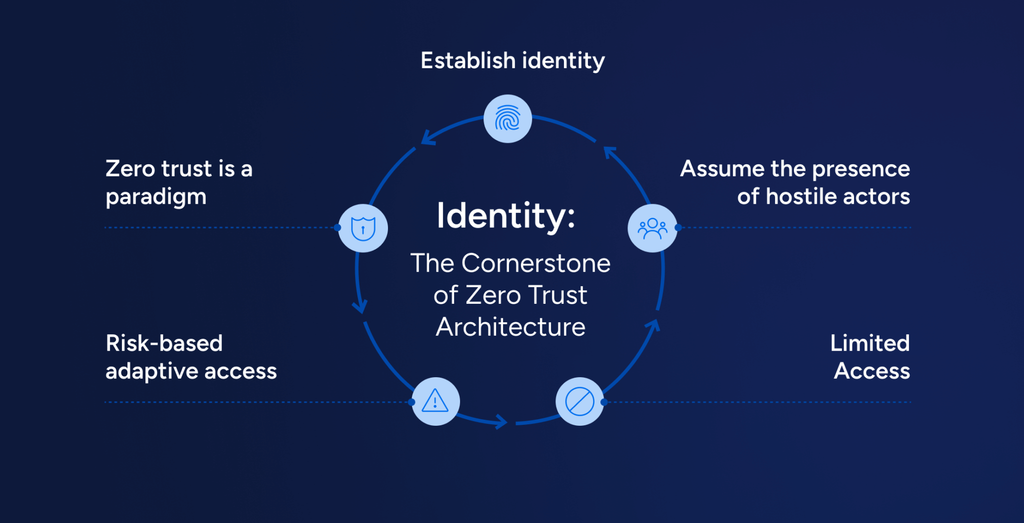
1. Identity as a Primary Security Control
Identity is central to modern security architecture.
Organizations should establish consistent authentication, authorization, and access governance practices across users, administrators, applications, and workloads.
Important considerations include multifactor authentication, privileged access management, identity lifecycle processes, and access policies informed by risk.
2. Device and Workload Trust
Access decisions should consider more than the identity requesting access.
Device health, configuration compliance, workload identity, and the security posture of connecting systems can provide important context.
Organizations should determine which signals are appropriate for their environments and how those signals influence access decisions.
3. Segmentation and Least Privilege
Effective segmentation reduces unnecessary communication between systems and helps limit lateral movement.
However, segmentation strategies must account for business applications, operational dependencies, and legitimate communication requirements.
Policies should be designed around verified business needs rather than assumptions about network boundaries.
4. Visibility and Continuous Monitoring
Organizations cannot effectively protect systems they do not understand.
Zero Trust architecture depends on sufficient visibility into identities, devices, applications, access patterns, and security events.
Logging, monitoring, and analytics should support the evaluation of access decisions, identification of abnormal behavior, and validation of security controls.
5. Governance and Measurable Outcomes
Zero Trust requires more than technical implementation.
Organizations need clearly defined responsibilities, documented security requirements, architectural standards, and measurable objectives.
Progress should be evaluated through meaningful improvements such as reduced unnecessary access, stronger authentication coverage, improved segmentation, and increased visibility into critical resources.
Start With Architecture, Not Products
A practical Zero Trust initiative should begin with an assessment of the organization’s existing environment.
Before selecting or expanding technology investments, security teams should understand:
- Which identities, applications, workloads, and data require protection.
- How users, devices, and systems currently communicate.
- Where excessive trust or unnecessary access exists.
- Which business processes and technical dependencies must be preserved.
- Which security capabilities are already available and where meaningful gaps remain.
This information provides the foundation for developing a prioritized Zero Trust roadmap.
Rather than attempting to transform the entire environment at once, organizations can focus on achievable improvements aligned with operational requirements and risk reduction.
Zero Trust Is a Continuous Journey
Zero Trust should not be treated as a one-time deployment or a final certification of an organization’s security posture.
Business requirements change. Applications evolve. Identities and devices are added or removed. New threats emerge.
An effective architecture must account for these changes through ongoing assessment, policy refinement, monitoring, and validation.
The most successful Zero Trust strategies are therefore designed to evolve alongside the organizations they protect.
Building a Stronger Security Foundation
At Cornerstone Summit Security Group, we believe effective cybersecurity begins with sound architecture.
Our approach emphasizes understanding the business environment, identifying meaningful risks, and developing practical security strategies that connect identity, networks, applications, devices, and data.
Zero Trust is not defined by the number of products an organization deploys. It is defined by how effectively its architecture establishes, enforces, and validates appropriate access.
A strong security foundation begins with deliberate design.